
Web design cost runs from about $500 for a set-up template to $50,000 and beyond for a custom build. Most small business sites land between $3,000 and $10,000 (The Web Design Association, 2026).
That’s the number. The rest of this page is about what happens after you say yes, which is the part almost nobody writes about.
We build websites in San Diego and we quote them every week. So this guide covers the payment schedule, the contract wording and the warning signs in a quote, alongside the prices. Those three things decide what you actually pay.
What does web design cost in 2026?
A template set-up starts near $500. A custom small business site runs $3,000 to $10,000, and an online shop can pass $50,000 (The Web Design Association, 2026).
WebFX puts the wider market at $1,000 to $30,000 and up, with bigger companies sometimes spending over $100,000 (WebFX, 2026).
Here is the whole market in one place. It is the only table on this page, so it carries everything you need to place yourself.
| What you’re buying | Price | Who it suits | Time |
|---|---|---|---|
| Single landing page | $300 to $1,500 | Testing one offer | 1 to 2 weeks |
| 5-page site, template | $500 to $3,000 | First website, sole trader | 1 to 3 weeks |
| 8 to 12 page custom site | $3,000 to $10,000 | Most small businesses | 6 to 12 weeks |
| Online shop | $5,000 to $50,000+ | Anyone selling online | 3 to 6 months |
| Large custom build | $50,000 to $100,000+ | Multi-market, heavy traffic | 6 months+ |
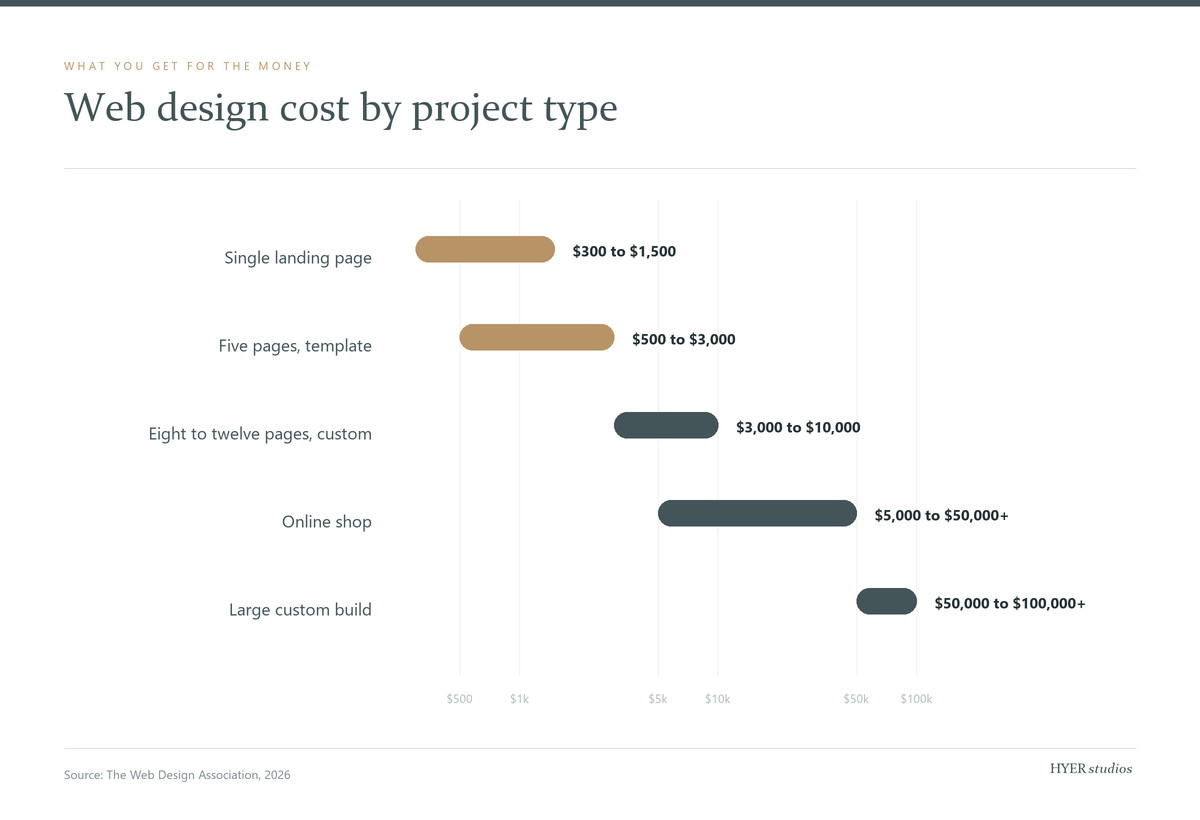
Price ranges from The Web Design Association and WebFX, 2026. Timings are our own build experience, not a promise.
Why two quotes for the same site differ so much
The jump from $3,000 to $10,000 is not extra pages. It is whether anyone works out what the site should say before the design starts.
At the bottom you buy production. Someone builds what you describe. At the top you buy decisions. Someone works out what the site needs to say, to whom, and in what order.
So ask each firm what happens in the first two weeks. If the answer is “we start designing”, you are buying production, and you should pay production prices.
How much do web designers charge per hour?
A mid-level freelancer averages about $58 an hour. A senior one averages about $103 (goLance, 2026).
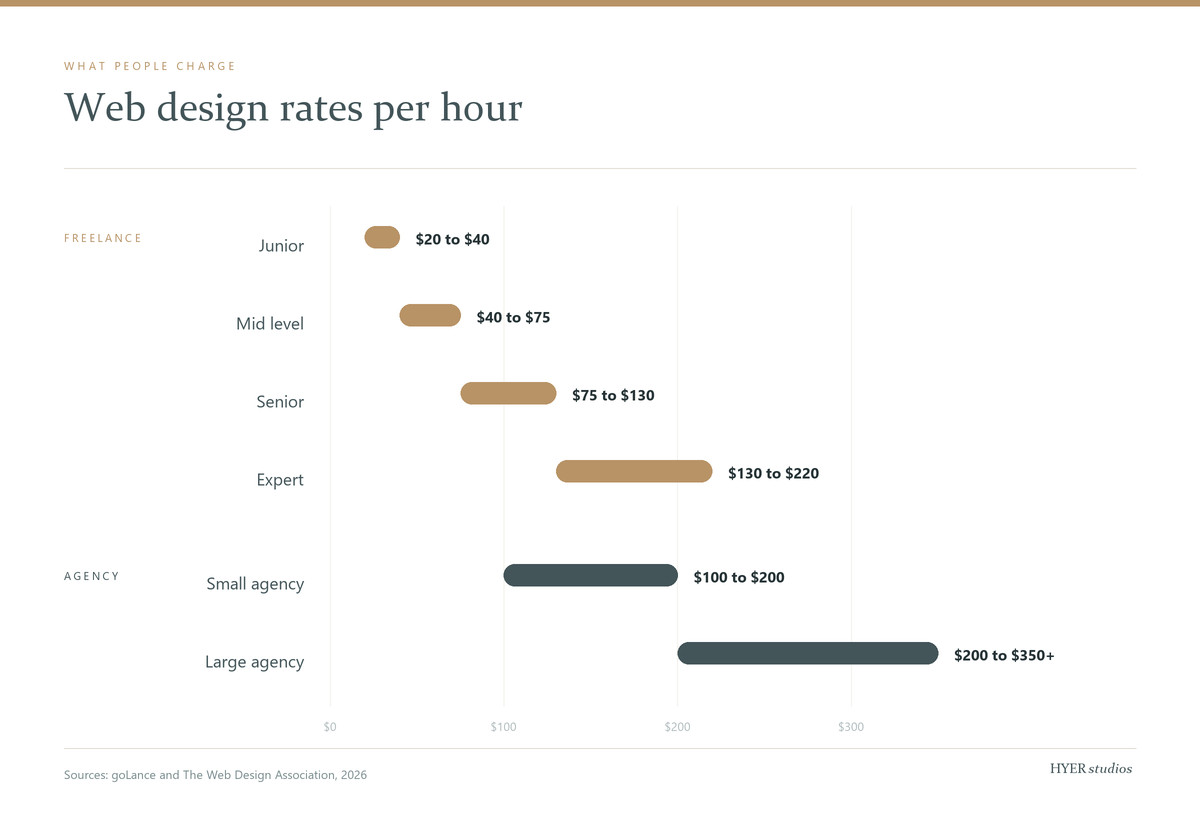
Rates run from $20 an hour for junior work up to $220 for the top of the market (goLance, 2026). Agencies sit higher because you are paying for a team.
What each type of person charges
Freelance rates by experience, from goLance’s 2026 figures:
- Junior, 0 to 2 years: $20 to $40 an hour. Fine for small, well-described jobs.
- Mid-level, 2 to 5 years: $40 to $75 an hour. Right for most projects.
- Senior, 5 to 10 years: $75 to $130 an hour. Runs the whole build.
- Expert, 10 years plus: $130 to $220 an hour. Top of the market.
Agencies price differently. A small agency charges $100 to $200 an hour and a large one $200 to $350 or more (The Web Design Association, 2026).
What the extra money buys
A freelancer is the best value when the job is small and clearly described. One person cannot design, build, write and test to a deadline without something slipping. If they get sick, your project stops.
An agency costs more because three or four people cover the same job. You are not paying for better design. You are paying so the work carries on when one person is away.
So pick on risk, not on rate. A $5,000 job rarely needs a team. A $30,000 job usually does.
Who should build it: a freelancer, an agency, or someone in-house?
A freelancer is best value on a small, clearly described job. An agency is worth the premium once the job is big enough that one person going quiet would stop it.
Hiring in-house is the most expensive option until you need more than about two sites a year. Then it becomes the cheapest. The tipping point is usually ongoing product work rather than one build.
What you give up at each level
A freelancer gives you one relationship and one point of failure. That is fine on a $4,000 job and uncomfortable on a $25,000 one.
An agency gives you cover and takes a margin for it. What you are actually buying is that someone on the team has made your project’s mistakes before, on somebody else’s money.
An in-house hire gives you full attention and no outside perspective. Sites built entirely in-house tend to reflect the org chart rather than the customer.
So match the choice to the size of the hole it would leave. If the project stopping for a month would hurt, pay for the team.
Working with a team in another country
The saving is real. So is the cost of the time difference.
A three-day gap between your feedback and their reply adds weeks across four rounds of changes. Weeks are where a fixed price quietly turns into an hourly one, because somebody has to absorb them.
If you go this route, agree a fixed overlap window each day. Two hours of shared working time removes most of the problem.
How much should a small business expect to pay?
Most small businesses spend $3,000 to $10,000 on a custom site of 8 to 12 pages (The Web Design Association, 2026). What pushes you up that band is rarely page count.
The thing that surprises people is forms. A five-page site with three forms, a link into your customer records and proper call tracking costs two to three times a five-page site with a contact page. The page count is identical.
So if the job of your site is to make the phone ring, budget for the plumbing, not the pages.
How much does a single landing page cost?
A standalone landing page runs $300 to $1,500 (The Web Design Association, 2026). The spread depends on whether it sits inside a site that already exists.
A page added to a site with an established look is production work. A page built from nothing is a small website with one page, and it gets priced that way.
When one page is genuinely enough
If you are testing an offer, running ads to a single campaign, or checking whether anyone wants the thing before you build the business around it, one page is the right purchase. It is also the fastest thing on this list to get live.
What pushes it to the top of the range
Custom photography. Forms that change depending on the answers. Two versions running against each other. A link into your customer records that actually works.
A page with all four is a project, not a page. Price it that way and you will not be surprised.
The mistake we see most
A landing page built on a separate tool, outside the main site, with its own look. It converts fine and Google effectively cannot see it, because it inherits nothing from your existing site.
That’s a fair trade for paid advertising. It’s a bad one if you expected the page to show up in search on its own.
How much does an online shop cost?
An online shop runs $5,000 to $50,000 and beyond (The Web Design Association, 2026). The number is driven by your product data, not your design taste.
Fifty products with clean photos and clear descriptions is a straightforward build. Five thousand products pulled from a supplier feed, with sizes, colours and stock counts that change hourly, is software.
What actually costs money in a shop
Payment is easy now. Shipping rules are not. Tax is not. Returns are not.
Work out in advance how you handle a customer in another state, an item that goes out of stock mid-order, and a refund on a part-shipped order. Each of those is a decision someone has to build.
The ongoing cost people forget
A hosted shop platform charges monthly and takes a slice of every sale. Add the paid extras that make it usable and the running cost often exceeds the build cost within two years.
That is not an argument against it. It is an argument for doing the two-year sum before you pick the platform, not after.
Does the platform you choose change the price?
Platform choice moves a build budget by roughly a third for the same set of features. The licence fee is rarely the issue. What matters is how much the platform hands you for free.
WordPress is the usual starting point for content-heavy sites. Shopify suits straightforward retail and costs less to build but more to run, because you pay monthly and give up a slice of each sale. Squarespace and Wix are cheapest and least flexible.
Going fully custom costs the most and is right when you genuinely need software rather than a website.
The question that settles it
Ask why they recommend their platform. If the answer is “it’s what we build on”, that’s honest and tells you nothing.
If the answer mentions how much you publish, how confident your team is, or a specific system you named, they have thought about your business. Most firms reading this should use WordPress or Shopify. Anything more exotic needs a reason you can say out loud.
What does a website cost per page?
Pricing by the page is usually a sign nobody has scoped the job properly. Pages are not the unit of work. Page designs are.
A forty-page site built from six repeating designs takes less work than a twelve-page site where every page looks different. If a firm quotes per page without asking how many different designs you need, they have measured the job rather than understood it.
When per-page pricing is fair
Two cases. Bulk writing, where you genuinely are buying forty pages of text at $150 to $500 each. And adding pages to a site that already has an established look, where the design exists and you are paying for production.
In both, ask what happens when a page needs a design that does not exist yet. That is where per-page pricing falls apart.
What the home page costs on its own
The home page is normally the most expensive single page in a build, often two to four times an inside page. It carries the most decisions, the most opinions and the most rounds of changes.
If you are launching in stages, the home page plus one repeating design is the smallest sensible first phase.
What makes one quote higher than another?
Eleven things explain nearly all the gap between two quotes. Page count is about fifth. Here they are in the order they actually move the price.
How many page designs, not how many pages
A forty-page site built from six repeating designs costs less than a twelve-page site where every page is different. Count the different-looking pages and you will get a far more accurate quote back.
Who writes the words
This is the line people miss. Writing runs $150 to $500 a page, so twelve pages can carry $2,000 to $6,000 before anyone designs anything.
Most late projects are late here. The design is finished and sitting there, waiting for text nobody was asked to write.
Whether your brand already exists
If you have a logo, colours, a typeface and a clear sentence about what you sell, you are buying a build. If you don’t, brand work comes first and that is its own budget.
Every outside system you plug in
Each connection is a small project on its own. A customer database, a booking tool, a payment system: each one needs scoping, testing and a plan for when it breaks.
Budget separately for each. The awkward ones always cost more than the estimate.
How fast you give feedback
Two rounds of changes is normal. The real cost is not the changes, it is the calendar. Take nine days to reply and a ten-week project becomes a sixteen-week one.
How many people have to approve it
Rarely quoted, and it predicts more than almost anything else. One decision-maker is fast. Seven people with no named final approver adds about a third to any timeline, and the cost follows the timeline.
Who supplies the photos
Stock images cost $10 to $500 each depending on the licence. A shoot costs more. Using your own photos is free and usually looks it, which is a fair trade if you make it on purpose.
Whether it has to work for disabled users
Building it in from the start adds a little. Adding it afterwards costs a lot. For many businesses this is a legal requirement, not a preference, so ask whether it is in the quote.
The list of old web addresses
This one is invisible and it is the most commonly missing line in the whole industry. If you are replacing a site, every old web address needs to point at its replacement.
Miss it and you launch a good-looking site that has lost every search ranking the old one had. We have seen that take nine months to recover. Ask whether that list is in the quote, in writing.
Launch day itself
Somebody has to move the domain, check the security certificate and make sure your email still works. It is small, real, and often nobody’s job. Confirm whose it is.
How much old content has to move
Every existing page that carries over has to be moved, checked and reconnected. On a site with a few hundred pages this is a real line, not an afterthought.
Automatic transfers are cheap and rarely clean. Budget for a person to look at every page, or accept that some will arrive broken and nobody will notice for months.
Whether anyone is measuring the result
A site built with tracking in place from day one costs a little more than one without. It is also the only way you ever find out whether the money worked.
Ask for it by name in the quote. If nobody is counting enquiries, every conversation about the next site will be an argument about opinions.
Whether you are in a hurry
Rushing costs more and buys you position in the queue, not speed. It cannot shorten the thinking at the start, and skipping that is how projects fail.
What does “works on mobile” actually mean in a quote?
Every quote says the site works on phones. There is a wide gap between what that can mean. Ask which version you are buying.
The cheap version is a layout that squashes down. Everything from the desktop page is still there, stacked, in the same order, just narrower. It passes a test and reads badly on a phone.
The version worth paying for starts from the phone. The order of the page changes. The menu is built for a thumb. Things that matter on a small screen move up, and things that don’t come off.
How to tell which one you’re getting
Ask to see two of their recent sites on your own phone. Not on a laptop window dragged narrow. On the actual device, on mobile data, standing outside.
If the menu is awkward, the buttons are small, or you have to pinch to read anything, that is the version you will get too.
Why it matters more than it used to
Most people who find you on a search are holding a phone. If the page is hard to use, they go back to the results and tap the next one.
So make it a line in the quote. “Designed for phones first, checked on real devices before launch.” If they will not write that, you know which version you were being sold.
Is it cheaper to use a template?
A template saves 40% to 70% of the design work and saves nothing on words, planning or connected systems. Those often make up more than half the job, so the saving is smaller than it looks.
On a $10,000 project, starting from a template might save $2,500 to $4,000. That is real money, and for plenty of businesses it is the right call.
Where it costs you later
Templates are built to suit everyone, so they carry code for things you will never use. That shows up as slower pages and a design that fights you when you want to change something in year two.
The pattern we see most often is a business that saves $3,000 on a template and spends $8,000 replacing it twenty months later.
So decide on purpose. If the site is a placeholder while you work out the business, buy the template. If it is the business, don’t.
What’s the difference between design cost and development cost?
Design is usually 30% to 40% of the bill and the build is 40% to 50%. The rest goes on planning, testing and launch.
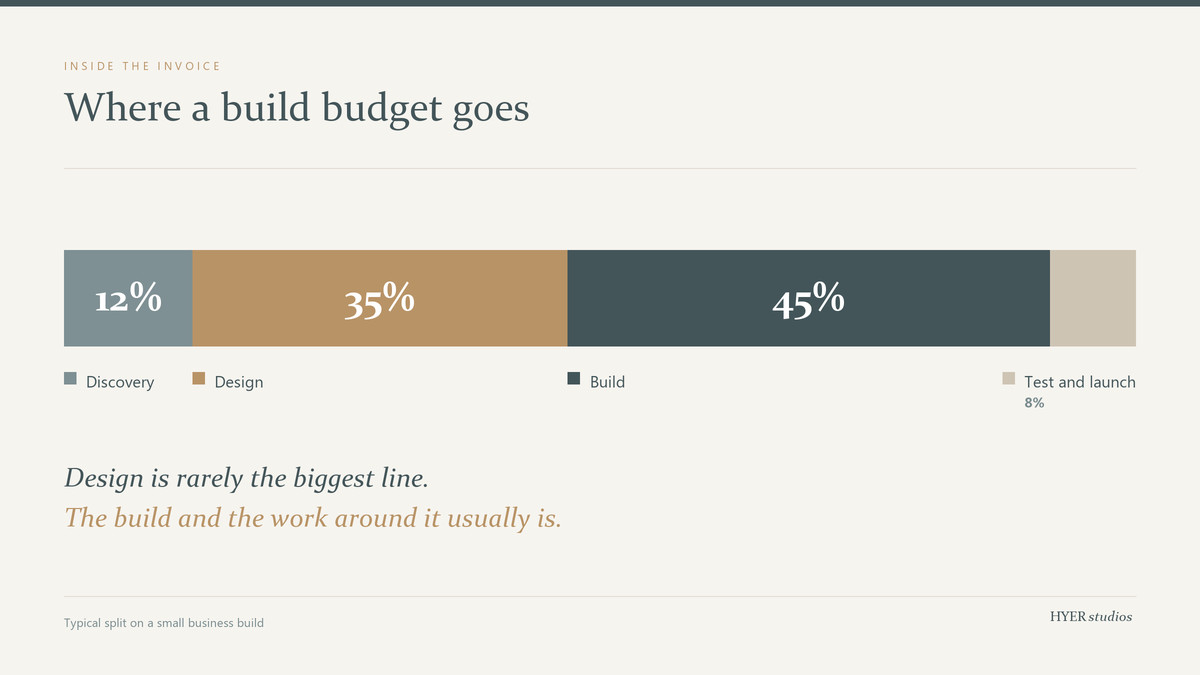
Design is what it looks like. Development is making it work: the code, the system you edit it in, the connections to everything else.
A quote showing one number and no split is hiding where the work goes. Ask for the breakdown. Any firm worth hiring gives you one without being pushed, and ours does too if you want to compare. Our web design services page lists what sits in each line.
How do you actually pay for a website?
Most firms take 30% to 50% up front, then bill at agreed stages until launch. The schedule affects your cash flow more than the total does.
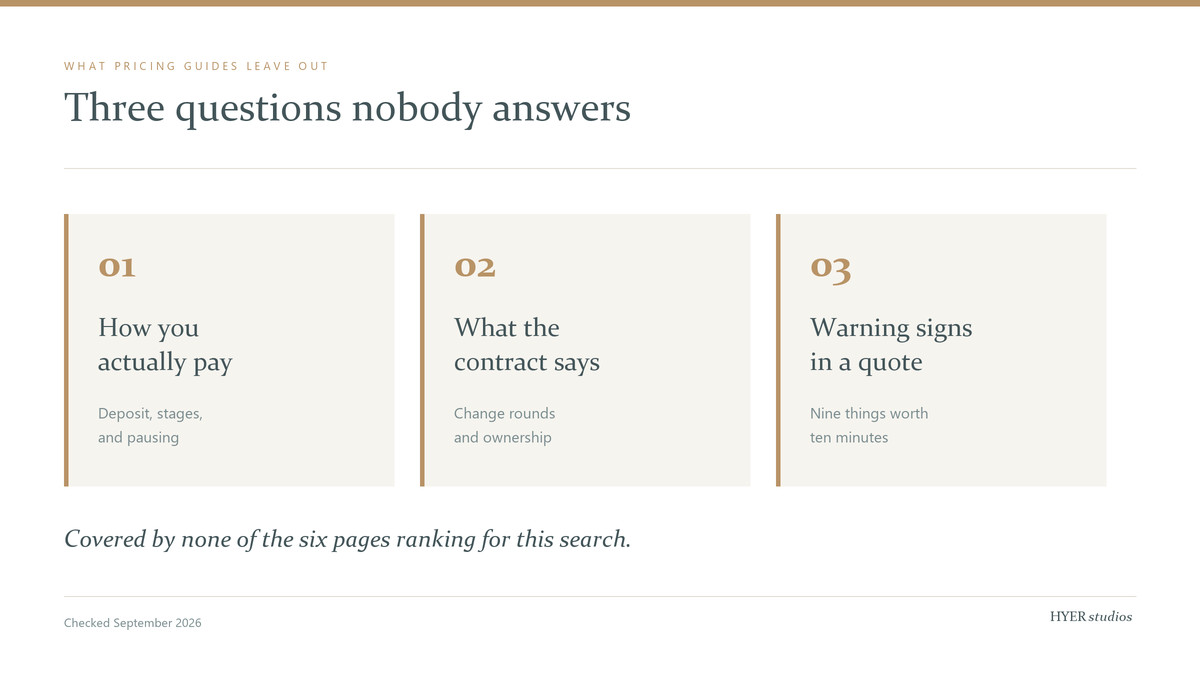
A $15,000 job paid in three parts and a $15,000 job wanting all of it on day one are not the same commitment. Yet almost no pricing guide mentions this.
The deposit
Under 25% usually means the firm is short of cash. Asking for 100% means you have nothing left to hold back if the work is late or wrong. Both are worth noticing.
The usual stages
On jobs over $10,000 the pattern is fairly standard. You pay something on signing, something when the design is approved, something when the build is finished, and the rest at launch.
Watch what you can still change at each point. Your room to move shrinks every time you pay, and it shrinks fastest right after you approve the design. That is the moment to be difficult if you are going to be.
Paying monthly instead
Some firms now build a site for a few hundred a month with nothing up front. The trade is ownership. You are renting.
Read what happens if you stop paying, because in most of these deals the site goes away. It suits a business that cannot find $12,000 and can find $400 a month, and it costs more over three years.
If you need to stop
Ask before you sign. If you pause for two months, does the job pick up where it left off, or go back in the queue? Is there a fee to restart?
Firms book work months ahead. An unplanned pause means someone’s time was held and not used, so somebody pays for it. Find out who.
What does the contract actually say?
The contract decides whether a $12,000 project stays $12,000. Read the change clause before you read the price.
Most overruns are not dishonesty. The scope was vague and each side remembered it differently.
What counts as one round of changes
This is the most expensive vague sentence in the industry. Is a round one change, or all your feedback sent at once? If you send eleven comments in one email, is that one round or eleven?
Get it written down. “One round is all your feedback, sent together, within five working days” prevents more arguments than any other line.
The change clause
Any decent contract has one. It should say how you ask for a change, how it gets priced, and that work stops until you agree the cost.
It protects you as much as them. Without it, extra work gets absorbed quietly until the goodwill runs out, and then the quality drops instead of the invoice rising.
Who owns what
Two separate questions: the finished site, and the working design files. Plenty of contracts hand over the site and keep the design files.
That is common and it is negotiable. It matters enormously the day you change firms, so settle it at the start.
What happens if either side walks away
A fair contract pays for work already done and releases nothing else. Check that both sides can end it. A contract only they can exit is not one you want.
Who owns the website when it’s finished?
You normally own it once you have paid in full, but “it” covers three separate things. Settle all three before you sign, not at the end.
The live site is one thing. The design files are another. Any custom code written for you is a third. Plenty of contracts hand over the first and keep the second.
Why the design files matter
The day you change firms, the design files decide whether the next team builds on your existing look or starts again. Starting again costs you thousands and it is entirely avoidable.
Ask for them in writing. Keeping them is a normal position for a firm to take and a normal thing for you to negotiate away.
The licence trap
Some sites are built on paid add-ons the firm licenses rather than owns. Those do not transfer with the site.
You can inherit an annual bill you never agreed to, or a site that stops working when their licence lapses. Ask which paid extras are in the build and whose name they are in.
What to do about it
Put one sentence in the contract. On final payment, you receive the live site, the design source files, and the rights to any custom code written for this project. If they will not agree to that, ask why, and weigh the answer.
What should go in the brief you send out?
A one-page brief gets you quotes you can actually compare. Without one, every firm scopes a different job and the prices mean nothing.
You do not need a document. You need six answers, written down once and sent to everyone.
The six things to write down
- What the site is for. One sentence. Enquiries, bookings, sales, or credibility.
- How many different page designs you think you need. Guess. They will correct you.
- Who writes the words. The single biggest variable in the price.
- What it has to connect to. Your customer records, a booking tool, a till system.
- What you already have. Logo, colours, photos, existing site.
- When you need it live, and why that date. A real reason changes how it gets built.
Why guessing the design count helps
Most people cannot say how many page designs they need, and that’s fine. Putting a number down anyway starts the right conversation.
A firm that says “actually you need four, not nine, and here’s why” has just saved you money and shown you how they think. A firm that quotes your guess without questioning it has told you something too.
What to leave out
Do not describe the design. Do not send three sites you like and ask for a blend of them. That is how you end up paying for taste instead of results.
Describe what the site has to do and let them tell you how it should look. If their answer is wrong, you have learned that cheaply.
What are the warning signs in a quote?
Nine things tell you a quote is weaker than it looks. Checking them takes about ten minutes.
- One number and no breakdown. You cannot compare it to anything, and you cannot tell what is missing.
- Unlimited changes. No business can absorb unlimited work, so it is priced in somewhere you cannot see.
- No planning stage. A quote after a twenty-minute call means nobody has worked out what the site should do.
- No named people. On a $20,000 job you should know who is doing the work before you sign.
- Hosting you cannot leave. Managed hosting is fine. Hosting that traps you is not. Ask who holds the passwords.
- Nothing about who writes the words. If it isn’t mentioned, assume it’s yours.
- A price that never changes when the job does. Either there is padding, or the quality drops when the work grows.
- No mention of disabled users. For many businesses that is a legal requirement, not a nice-to-have.
- Everything up front. Below about $2,000 that’s normal. Above it, you have given away every bit of bargaining power.
The single best question to ask: what is not in this quote that most clients assume is? A good firm answers straight away.
Should you pay hourly or a fixed price?
Most established designers prefer a fixed project price, and for you that’s usually better too (The Web Design Association, 2026). You know the total, and you are not punished if the work takes longer.
Hourly suits work where nobody can know the scope: fixing someone else’s site, or ongoing improvements. If you do agree hourly, agree a ceiling as well. Hourly with no cap hands all the risk to you.
A monthly retainer beats repeated small jobs when the site needs constant work, because you stop paying to get someone up to speed every time. Just define what the hours buy, or it quietly becomes insurance you never claim on.
How long does a website take to build?
A template takes one to three weeks. A custom small business site takes six to twelve weeks. The thing that moves those numbers most is not the firm. It is you.
Late text is the leading cause of overrun. Slow approvals are second. Take nine days to reply on a two-week review and you add a month to a ten-week job.
At a fixed price, that costs you time. On an hourly rate it costs you money, because the team has to re-learn a job it put down three weeks ago.
So work out who is writing the words and when, before you sign. If the answer is “me, in the evenings”, add four weeks to whatever you were quoted. That is not cynicism. It is the most reliable pattern in this business.
Does a redesign cost less than starting again?
A redesign usually costs 60% to 80% of a new build, and sometimes more. The saving comes from what you keep. The extra comes from what you have to work around.
If your words are good, your page structure makes sense and the platform isn’t the problem, a redesign is straightforwardly cheaper. That is the common case for a site that has simply aged.
When starting again is cheaper
Three signs. The platform is old or was heavily changed by someone you can no longer reach. The words are thin or wrong. The page structure grew by accident and nobody can explain it.
In those cases you spend the savings on digging, and you still end up rebuilding.
Moving your existing pages across
Expect $5 to $25 a post for a clean move with the formatting and images intact. On a blog with 200 posts that’s $1,000 to $5,000, and it is the line most often left out of a redesign quote.
Automatic transfers are cheaper and rarely clean. Budget for someone to check every page, or accept that some will break quietly.
What does a website cost after it launches?
Running a site costs roughly 15% to 25% of the build price every year. Almost none of it appears in a design quote.
WebFX puts typical ongoing spend at $501 to $5,000 a year for most businesses (WebFX, 2026).
You pay for the domain, the hosting, any paid add-ons, and someone keeping it updated. You also pay for the fixes that surface in the first few months, because every site has some.
The one people regret skipping is maintenance. An unmaintained site is a break-in waiting for a quiet week, and cleaning up afterwards costs more than a year of looking after it properly. Budget for website maintenance from month one.
What does a maintenance plan actually cover?
A maintenance plan should cover updates, backups, security checks and a set number of small changes each month. If it does not list all four, ask what you are paying for.
Most plans are priced monthly and most are worth having. The problem is that “maintenance” means different things at different firms, and the differences only show up when something breaks.
The four things to check
- Updates. Who applies them, how often, and who checks the site still works afterwards.
- Backups. How often, where they are kept, and how quickly a site can be put back.
- Security. What gets monitored, and what happens at 2am on a Sunday.
- Small changes. How many hours a month, and what rolls over if you don’t use them.
The question that separates plans
Ask what happens if the site goes down. Not what they do to prevent it. What happens when it has already happened.
A real plan has an answer with a time in it. A weak one has an answer with the word “promptly” in it.
Why skipping it costs more
An unmaintained site is a break-in waiting for a quiet week. Cleaning up afterwards routinely costs more than a year of looking after it properly, and your site is offline while it happens.
That is the whole argument. It is not a upsell, it is the cheaper of two bills.
How do you compare three quotes fairly?
Quotes are almost never comparable as written, because every firm describes the job differently. Line them up against your own list first or you will simply pick whoever left the most out.
Write down what you are actually buying. Count the different page designs. Name who writes the words. Fix the number of change rounds. List the outside systems one by one. Confirm whether the list of old web addresses and the first few months of support are included.
Then ask all three the same four questions. Who exactly does the work? What is not included? What happens if we are late with the text? How does a change get priced?
Compare the answers, not the prices. A 20% to 30% spread across three quotes is normal. A 300% spread means they are not quoting the same job, and your description was not clear enough.
What should be on your quote comparison checklist?
Eight lines tell you whether three quotes describe the same job. Print them, fill them in for each firm, and the cheapest quote often stops being the cheapest.
Check each quote for these, one by one:
- Is there a planning stage before design starts? Yes or no, and how long.
- How many different page designs are quoted? Not pages. Designs.
- Who writes the words? Them, you, or split.
- How many rounds of changes, and what counts as one?
- Are the outside systems listed separately? Each one named and priced.
- Is the list of old web addresses included? The single most common omission.
- Does it say anything about disabled users? A legal requirement for many businesses.
- How many months of support after launch?
A firm that answers all eight without hesitating has done this before. One that goes quiet on two or three has told you where the surprises will come from.
What does a cheap website really cost you?
The cheapest quote is often the most expensive purchase, and the gap shows up in about eighteen months. Not always. But often enough to check.
A $1,500 site that brings in nothing costs more than a $9,000 site that brings in two jobs a month. The price is only half the sum.
Where the money leaks
Cheap builds skip the planning, the words and the list of old web addresses. Each of those is invisible on launch day and expensive six months later.
Skip the planning and you get a site that looks fine and says nothing. Skip the words and you get placeholder text that quietly stays. Skip the redirect list and you lose every search ranking the old site had.
The pattern we see
A business saves $3,000 choosing the cheapest quote. Eighteen months later they pay $8,000 to replace it, because the thing cannot be changed without breaking.
Total spend: $11,000, for a site they could have had for $9,000, eighteen months later than they could have had it.
How to avoid it without overpaying
Do not pick on price. Pick on what is in the quote, using the eight-line checklist further up this page.
If the cheapest quote covers all eight lines, buy it with confidence. If it covers four, it is not cheaper. It is smaller, and you will pay for the rest later.
How do you spend less without ruining it?
Four things reliably cut the bill. Everything else just moves the cost somewhere later.
- Launch in stages. Ship the pages that earn, add the rest after. Eight good pages live in week eight beat twenty-four pages live in month seven.
- Write the words yourself. The biggest line you control. Be honest about whether you actually will.
- Use fewer page designs. Six good ones beat fifteen average ones, and the site looks more consistent.
- Use your own photos. Real pictures of real people cost nothing and work better than stock.
Four things are never worth cutting: the planning, the list of old web addresses, accessibility and testing. None of them show in the finished site and all of them cost more to add later. Cutting those isn’t saving money. It is borrowing it.
What share of your budget should a website be?
The common rule puts a site at 10% to 20% of a year’s marketing spend in the build year, then 3% to 5% after. It’s a useful sanity check and a poor decision-making tool.
For a start, it assumes you have a marketing budget. Plenty of profitable small businesses don’t. For them the site is a capital purchase competing with a van or a hire, and the percentage means nothing.
Where the rule breaks at both ends
A business spending $2,000 a year on marketing cannot build a $400 website worth having. A business spending $2 million does not need a $400,000 one.
WebFX puts typical ongoing spend at $501 to $5,000 a year for most businesses (WebFX, 2026), which is a more useful anchor than any percentage.
The better question
Work backwards from what the site has to bring in, using the sum further down this page. If it needs twelve extra enquiries over three years and you already get forty a year, the decision makes itself.
If you would need to double your enquiries to justify it, scope it down or spend the money on getting found first. A better website does not create demand. It converts the demand you already have.
What should you ask before you sign anything?
Six questions, asked of every firm, tell you more than any portfolio will. Ask them in the same order and compare the answers side by side.
- Who specifically does the work, and will I meet them? Firms that sell with senior people and deliver with juniors rely on nobody asking.
- What is not in this quote that most clients assume is? A good firm answers in one breath. Hesitation here is information.
- What happens if we are late with the words? You will be late. Find out now what it costs.
- How does a change get priced, and does work stop while we agree it? The answer should be yes.
- What do we own at the end, and does that include the design files? Three separate things, one question.
- Can I speak to a client whose project went badly? The most revealing question on this list.
Why the last one works
Every firm has a project that went wrong. The ones worth hiring will tell you about it, explain what they changed afterwards, and often let you speak to the client anyway.
A firm that claims nothing has ever gone wrong is either new or not being straight with you. Neither is what you want on a $20,000 job.
What to do with the answers
Write them down during the call. Not after. The differences between three firms are clearest when you can read the answers next to each other on one page, and they fade within a day.
If one firm answers all six plainly and another talks around two of them, you have your decision, whatever the prices say.
Is a new website worth the money?
Work it out on your own numbers rather than on industry statistics. Most of the figures you’ll see quoted on this question are older than they look.
The claim that 75% of trust comes from design traces back to Stanford research published in 2002. The “94% of first impressions are design” figure comes from a 2012 study of health websites. Neither was about a small business buying a site in 2026.
The most quoted of all, a 9,900% return on design spend, is usually credited to Forrester. We went looking for the original document and could not find it. Treat it as folklore.
The sum that actually helps
Take what an average customer is worth. Multiply by how often you win the ones who contact you through the site. That’s what one enquiry is worth.
Divide the build price by that number. Now you know how many extra enquiries the site has to bring in before it has paid for itself.
A trade business with a $900 average job, winning half its website enquiries, earns about $450 an enquiry. A $5,000 site needs eleven extra enquiries. That’s under one a month.
Write your version of that sentence down before you sign anything. If nobody involved can say what the site has to achieve, the budget conversation is guesswork in a spreadsheet.
When the answer is no
If all your work comes by referral, and nobody decides based on your website, a $15,000 build may be the wrong purchase. Spend it on whatever does move your revenue.
A firm willing to tell you that is worth keeping. We have told people that, and we would rather say it before you spend than after.
What do $4,000, $14,000 and $40,000 actually buy?
Three composite projects at three price levels, with the scope behind each number. These are typical market builds, not quotes.
A $4,000 build
Seven pages on a customised theme. You supply the words and the photos. Two rounds of changes, a contact form, basic tracking, and a redirect list covering the old site.
Five weeks is normal, and three of those usually go on waiting for the About page.
A $14,000 build
Fourteen pages across six designs for a business with more than one location. The agency writes about half of them. Custom design system, a link into your customer records, call tracking, accessibility built in from the start, and a staged move of an existing blog.
Eleven weeks is normal. The connected systems are what run over, not the design.
A $40,000 build
A booking platform with availability, staff calendars, deposits and automatic notifications. Full discovery, user research, custom development, an outside accessibility audit and three months of support after launch.
Five to six months. Most of the money is not design. It is the fifth of the work that turns out to be genuinely hard.
Use these as a sense check against a quote in front of you, not as a price list. Scope moves these numbers more than anything else does.
What else do people ask about web design cost?
These are the questions we get asked most often on a first call. Short answers, with the source next to the number.
How much do web designers charge?
A mid-level freelancer averages about $58 an hour and a senior one about $103 (goLance, 2026). Small agencies charge $100 to $200 an hour, large ones $200 to $350 or more (The Web Design Association, 2026).
How much does a small business website cost?
A custom site of 8 to 12 pages runs $3,000 to $10,000 (The Web Design Association, 2026). Below $3,000 you are buying a template with your logo on it. Above $10,000 you are usually paying for connected systems or writing, not extra pages.
Can I get a website for under $1,000?
Yes. A single landing page runs $300 to $1,500 and a five-page template site starts near $500 (The Web Design Association, 2026). The catch is your own time. If the site has to bring in work, this is usually false economy.
Is search optimisation included in the price?
Rarely, and it is the most common misunderstanding we meet. Most quotes cover the technical basics, such as tidy web addresses and the list pointing old pages at new ones. They do not cover keyword research or content work. That sits with an SEO agency, whether that’s the same firm or a different one.
What is a redirect list and do I need one?
It is a document pointing every old web address at its replacement. If you are rebuilding an existing site, you need one. Without it you lose the search rankings your old pages held, and that takes months to win back.
Do I own the website when it’s finished?
Usually once you have paid in full, but check three things separately: the live site, the design files, and any custom code. Plenty of contracts hand over the site and keep the design files.
How much should I hold back until launch?
Keep at least 10% to 20% of the total until the site is live and working. It is the only part of the deal that still has your attention on it.
Firms expect this and most build it into their own schedule. One that wants everything before launch is asking you to carry all the risk on the last and most fragile stage of the job.
Should I pay for a site I cannot edit myself?
Only if you never plan to change it. Ask to be shown the editing screen before you sign, on a real page, with someone timing how long a text change takes.
If it takes more than two minutes, you will not do it, and you will pay them every time instead.
Where should you start?
Count your page designs, decide who writes the words, and name one final approver. Those three choices move the price more than any negotiation will.
Count your different page designs. Decide who writes the words. Name one person who gives final approval. Those three choices move the price more than any negotiation will.
When you compare quotes, compare the contracts too. The payment stages, the definition of a change round and the change clause decide what you actually pay. Almost nobody reads them twice.
If you have a quote in front of you and want a second opinion on it, send it over. We will tell you what’s missing from it, including when the answer is that you should take it.
About the author
Brian Esper founded Hyer Studios in San Diego in May 2020, working with downtown and Little Italy hospitality businesses through COVID. He co-founded Frends Beauty in 1996 and Stilazzi Cosmetics in 2008, so he has bought websites as an owner before selling them as an agency. Hyer Studios is at 6977 Navajo Rd, Ste 130, San Diego, CA 92119.