
Local SEO for Taxi Companies
Ride-hailing apps took the on-demand ride. They did not take the airport transfer booked three weeks out, the wedding, the standing corporate account, or the medical transport contract. That work is still chosen through search, it is worth far more per booking, and most operators are invisible for it.
Book Your Free 30-Minute Audit
Book Your Free 30-Minute Audit
Why do most taxi companies lose to the apps online?
| What's different? |
On-demand ("taxi near me") |
Booked ahead (airport transfers, weddings, corporate, medical) |
|---|---|---|
| What they search | "taxi near me", "cab now" | "airport transfer [city]", "wedding limo hire", "medical transport" |
| Decision window | Seconds | Days to weeks |
| Where it is decided | The app already on their phone | Google, then a phone call |
| Who wins it | Uber, Lyft | Whoever is visible and answers |
| Value per booking | Lowest | Highest |
| Can you win it? | Rarely | Yes, and this is the opportunity |
5,568
Page one of Google, sixteen months, not a single click.
We learned this the hard way on our own website. Four of our pages showed up in Google search results 5,568 times over sixteen months. One of them sat near the top of the first page. Total clicks from all four: zero. Not one person clicked through. The map at the top of the page answered the search, so nobody ever scrolled down to us.
Ranking is not the goal. Being reachable at the moment of decision is the goal.
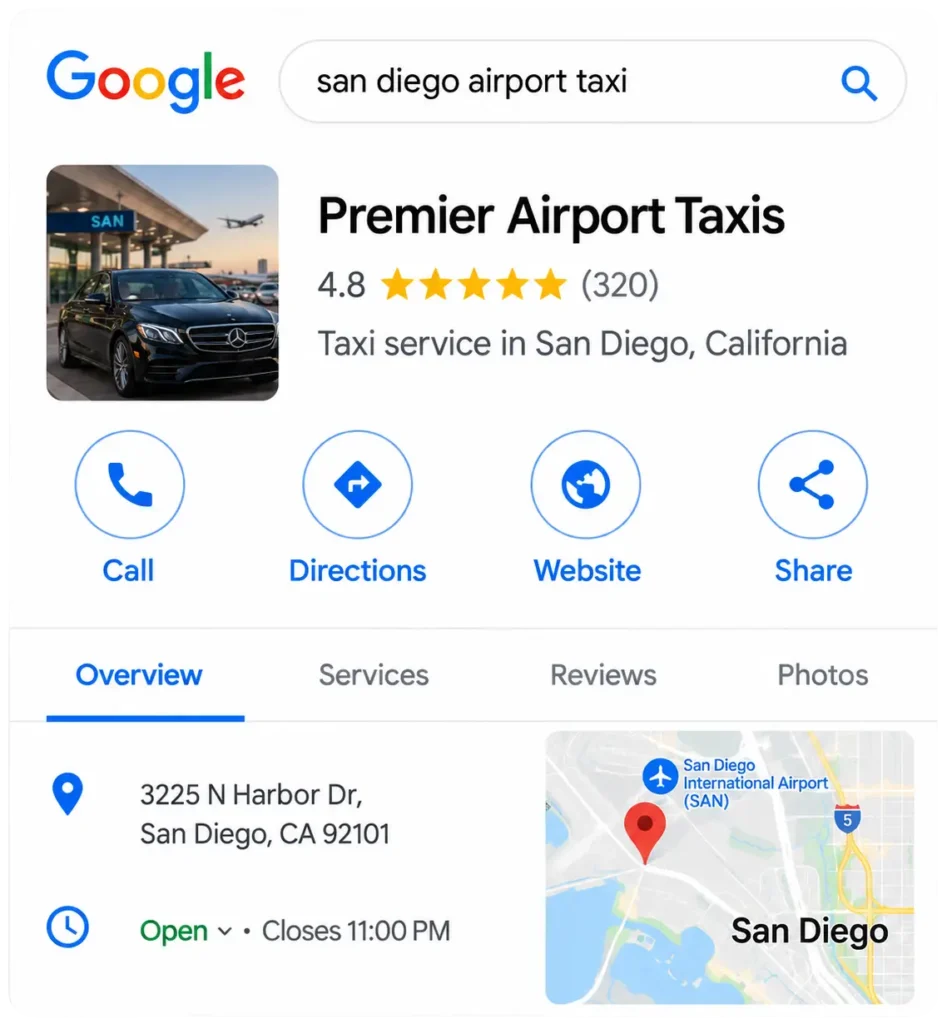
On a search like “taxi near me,” Google puts a map at the top and people tap the first thing they see. Almost nobody scrolls past it. So we spend your budget on the searches where the customer is still deciding, not the ones already answered.
What does local SEO for a taxi company include?
Google Business Profile
Categories, service area, vehicles, hours, photos and booking links. This is where local transport search is decided, so it is where we start.
Service and route pages
One page per thing you sell: airport transfers, corporate accounts, weddings and events, medical transport, hourly hire. Each is a different search with a different buyer.
Reviews
A process for asking at the right moment, in the vehicle, and replies that read like a person wrote them.
The booking path
If someone cannot get a quote in two taps on a phone, ranking changes nothing. We fix the website before we send traffic to it.
Reporting
How many people found you without already knowing your name, how many called, how many booked. Measured against where you started, so you can see what moved.
Should your Google listing show your address?
No. Your drivers go to the customer, so Google wants you to hide the address and show the areas you cover instead.
Google says it plainly: “If you’re a service-area business, you should hide your business address from customers.” Instead you set the areas you serve on your listing.
This is worth five minutes of your time. Getting it wrong is one of the most common reasons a transport listing gets suspended, and a suspended listing means you disappear from the exact searches this page is about. Most operators have never been told about it.
Which parts of a transport business are worth optimising for?
Airport transfers, corporate accounts, weddings and events, and medical transport. All four are booked in advance, and none of them belong to the apps.
Airport transfers
Searched days or weeks ahead, often with a flight number attached. The customer wants certainty, not the cheapest fare.
Corporate accounts
One search can be worth years of repeat bookings. Almost nobody optimises for it.
Weddings, proms and events
Planned months out, seasonal, and decided on trust and on what the vehicle looks like.
Non-emergency medical transport
The one most operators miss. Federal law says every state has to get Medicaid patients to their appointments if they have no other way to get there. Taxis are one of the approved ways. That is steady work on a repeating schedule. The person booking is a clinic or a care home, not a passenger. They pick you because they found you and trusted you, not because you were cheap.
Do you also work with limo and private car services?
Yes. Limo, black car, chauffeur, shuttle and party bus operators have the same problem as taxi firms and a better version of the opportunity, because their work is almost entirely booked ahead.
A limo company was never really competing with a ride-hailing app. It competes with other limo companies, on visibility and on how fast someone can get a quote. That is a search and conversion problem, and it is a solvable one.
What does it cost?


Who does the work?
Brian Esper, who founded HYER Studios in San Diego in 2020 after two decades running businesses of his own.
Frequently Asked Questions
Is local SEO worth it for a small taxi company
Often more than for a large one. Competition on these terms is unusually low, and a single recurring corporate or medical transport account can cover the cost of the work several times over.
Can we realistically compete with Uber and Lyft?
Not on on-demand, and we would not advise trying. On airport transfers, contracts, weddings and medical transport the apps are weak, and a reliable local operator wins by being findable and answering the phone.
Do we need a mobile-friendly website?
Yes, and more than most industries. Transport searches happen on a phone, often while travelling or standing outside somewhere. If your quote form does not work one-handed, ranking will not save it.
Do we need separate pages for airport transfers and weddings?
Yes. Different searches, different intent, different buyer. One combined services page competes for both and wins neither, and it is the most common structural problem we find on transport websites.
What happens if we stop?
Yes. Different searches, different intent, different buyer. One combined services page competes for both and wins neither, and it is the most common structural problem we find on transport websites.